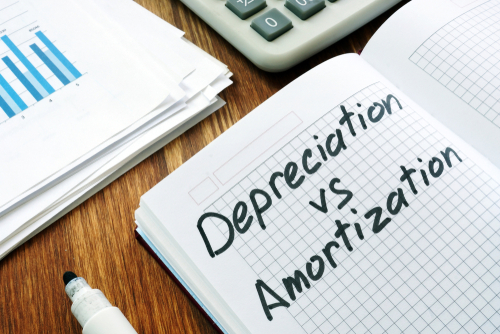
When there’s a question of the benefit that tangible or intangible assets provide businesses, there are many factors that must be weighed to make internal accounting procedures effective. Businesses must determine how the cost of business assets can be expensed each year over the asset’s lifespan. Looking at how amortization and depreciation work, implementing both processes depend on the type of asset being expensed. There are noticeable differences for each method, including how to salvage value is considered, whether accelerated expensing is allowed, and how each type is expressed on financial statements.
Amortization
Amortization is an accounting practice of spreading the cost of an intangible asset over its useful life. Examples of intangible assets, according to the Internal Revenue Service’s “Section 197 Intangibles,” include goodwill, intellectual property such as trademarks, patents, and government or agency-granted permits or licenses. These are all assets that must be amortized over 15 years.
Based on IRS regulations, when it comes to determining how an asset is expensed over its useful life, amortization is most similar to the straight-line basis method of depreciation.
It’s important to note that the timeframe of amortization is subject to interpretation. Examples, according to the IRS, include a 36-month amortization timeline for computer software because it’s not categorized as an asset under the same IRS Section. Other examples not mandated to be amortized under a 15-year time frame include interests to land, business partnerships, financial contracts (such as interest rate swaps) or creation of media.
Depreciation
One of the main differences when it comes to depreciation is that it focuses on tangible or fixed assets and requires a certain percentage of its useful life to be allocated each year. Examples of assets that can be expensed include trucks for service calls, computers, printers, equipment for production, etc. Another important difference is that the asset’s salvage value is deducted from the asset’s starting cost. The remaining balance (original cost – salvage cost) determines annual expensing amounts, which is divided by the asset’s years of useful life.
Along with the above method of depreciation, also called “Straight-Line Method,” there are other ways depreciation can determine how much is expensed annually and over the asset’s useful life. For example, Declining Balance or Double Declining Balance methods are alternate ways businesses can depreciate their assets – some frontload the amounts to take advantage of accounting/tax rules to reduce their tax liabilities. Another way is to depreciate via Units of Production. This method pro-rates the level of an asset’s expected use within a particular accounting period, on a per-unit basis, to determine how much the company can expense during a particular accounting timeframe.
When it comes to accounting for goodwill, according to a November 2020 electronic survey of CFA charter holders by the CFA Institute, respondents found that investors who see amortization used by companies still require investors’ due diligence. Sixty-one percent of respondents said there need to be alternate ways to figure out if management is effective or not, and 63 percent said that amortization “distorts financial metrics.”
When it comes to understanding and navigating the differences between amortization and depreciation, business owners and investors need to be well-versed in performing due diligence to ensure compliance.
When there’s a question of the benefit that tangible or intangible assets provide businesses, there are many factors that must be weighed to make internal accounting procedures effective. Businesses must determine how the cost of business assets can be expensed each year over the asset’s lifespan. Looking at how amortization and depreciation work, implementing both processes depend on the type of asset being expensed. There are noticeable differences for each method, including how to salvage value is considered, whether accelerated expensing is allowed, and how each type is expressed on financial statements.
Amortization
Amortization is an accounting practice of spreading the cost of an intangible asset over its useful life. Examples of intangible assets, according to the Internal Revenue Service’s “Section 197 Intangibles,” include goodwill, intellectual property such as trademarks, patents, and government or agency-granted permits or licenses. These are all assets that must be amortized over 15 years.
Based on IRS regulations, when it comes to determining how an asset is expensed over its useful life, amortization is most similar to the straight-line basis method of depreciation.
It’s important to note that the timeframe of amortization is subject to interpretation. Examples, according to the IRS, include a 36-month amortization timeline for computer software because it’s not categorized as an asset under the same IRS Section. Other examples not mandated to be amortized under a 15-year time frame include interests to land, business partnerships, financial contracts (such as interest rate swaps) or creation of media.
Depreciation
One of the main differences when it comes to depreciation is that it focuses on tangible or fixed assets and requires a certain percentage of its useful life to be allocated each year. Examples of assets that can be expensed include trucks for service calls, computers, printers, equipment for production, etc. Another important difference is that the asset’s salvage value is deducted from the asset’s starting cost. The remaining balance (original cost – salvage cost) determines annual expensing amounts, which is divided by the asset’s years of useful life.
Along with the above method of depreciation, also called “Straight-Line Method,” there are other ways depreciation can determine how much is expensed annually and over the asset’s useful life. For example, Declining Balance or Double Declining Balance methods are alternate ways businesses can depreciate their assets – some frontload the amounts to take advantage of accounting/tax rules to reduce their tax liabilities. Another way is to depreciate via Units of Production. This method pro-rates the level of an asset’s expected use within a particular accounting period, on a per-unit basis, to determine how much the company can expense during a particular accounting timeframe.
When it comes to accounting for goodwill, according to a November 2020 electronic survey of CFA charter holders by the CFA Institute, respondents found that investors who see amortization used by companies still require investors’ due diligence. Sixty-one percent of respondents said there need to be alternate ways to figure out if management is effective or not, and 63 percent said that amortization “distorts financial metrics.”
When it comes to understanding and navigating the differences between amortization and depreciation, business owners and investors need to be well-versed in performing due diligence to ensure compliance.
These articles provide general information on tax, accounting, and financial topics for small businesses and individuals. They are educational in nature and are not specific legal, accounting, financial, tax, or other professional advice, and should not be relied upon as such. This content was prepared by Service2Client and may have been reviewed or edited by the website owner for accuracy and compliance. Look for a trust mark below for verification details. No representation is made that any approach described will achieve a particular result, and no regulatory or professional body has reviewed or endorsed this content. Because each situation is different, readers should consult a qualified professional about their specific circumstances before acting. Images accompanying these articles are protected by copyright and may not be copied or reused.
To provide the best experiences, we use technologies like cookies to store and/or access device information. Consenting to these technologies will allow us to process data such as browsing behavior or unique IDs on this site. Not consenting or withdrawing consent, may adversely affect certain features and functions.
Functional
Always active
The technical storage or access is strictly necessary for the legitimate purpose of enabling the use of a specific service explicitly requested by the subscriber or user, or for the sole purpose of carrying out the transmission of a communication over an electronic communications network.
Preferences
The technical storage or access is necessary for the legitimate purpose of storing preferences that are not requested by the subscriber or user.
Statistics
The technical storage or access that is used exclusively for statistical purposes.The technical storage or access that is used exclusively for anonymous statistical purposes. Without a subpoena, voluntary compliance on the part of your Internet Service Provider, or additional records from a third party, information stored or retrieved for this purpose alone cannot usually be used to identify you.
Marketing
The technical storage or access is required to create user profiles to send advertising, or to track the user on a website or across several websites for similar marketing purposes.
 When there’s a question of the benefit that tangible or intangible assets provide businesses, there are many factors that must be weighed to make internal accounting procedures effective. Businesses must determine how the cost of business assets can be expensed each year over the asset’s lifespan. Looking at how amortization and depreciation work, implementing both processes depend on the type of asset being expensed. There are noticeable differences for each method, including how to salvage value is considered, whether accelerated expensing is allowed, and how each type is expressed on financial statements.

